> ## Documentation Index
> Fetch the complete documentation index at: https://docs.galtea.ai/llms.txt
> Use this file to discover all available pages before exploring further.
# Product
> A functionality or service evaluated by Galtea
## What is a Product?
A product in Galtea represents a functionality or service that you want to evaluate. Examples include *QA chat*, *Summarization*, or *Content Generation*.
Even if your organization has a single public-facing product (like a website or dashboard for all user interactions), you should define separate Galtea products for each distinct functionality you want to evaluate.
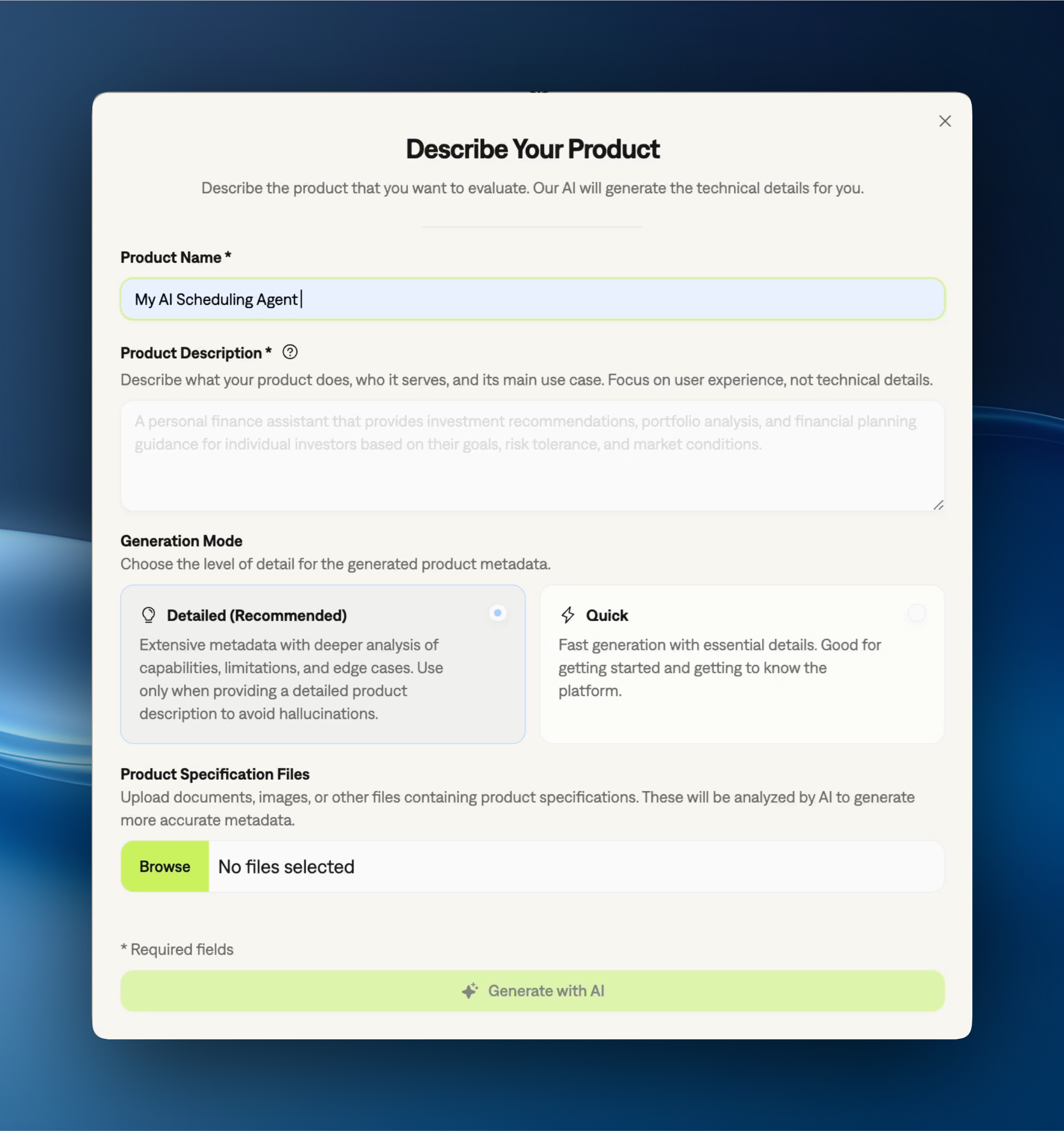
You can **register**, view and manage your products on the [Galtea dashboard](https://platform.galtea.ai/). Products can also be viewed and managed programmatically using the [Galtea SDK](/sdk/api/product/service).
 ## SDK Integration
The SDK allows you to list existing products, retrieve specific products by their ID or name, and delete products. Product registration is done through the [Galtea dashboard](https://platform.galtea.ai/). See the [Product Service API documentation](/sdk/api/product/service) for more details.
Manage products using the Python SDK
## Product Properties
The name of your product.
**Example**: "Document Summarizer"
Describe what your AI product does, who it serves, and its main use case. Focus on user experience, not technical details.
## SDK Integration
The SDK allows you to list existing products, retrieve specific products by their ID or name, and delete products. Product registration is done through the [Galtea dashboard](https://platform.galtea.ai/). See the [Product Service API documentation](/sdk/api/product/service) for more details.
Manage products using the Python SDK
## Product Properties
The name of your product.
**Example**: "Document Summarizer"
Describe what your AI product does, who it serves, and its main use case. Focus on user experience, not technical details.
- What to include: What the product does, who uses it, and its primary purpose.
- What to avoid: Technical implementation details or internal jargon.
Learn how to write effective product descriptions in our detailed guide.
Example: "A mobile sales assistant that helps customers find and compare smartphones based on their needs and budget."
List what your product is designed to do and what information it has access to. This helps Galtea generate targeted test cases.
Example: "Can answer questions about phone specifications, recommend devices based on user preferences, can access past user purchases, compare prices across models, and provide information about warranties and accessories."
List what your product cannot do — information it does not have access to, tools it cannot use, and its general scope boundaries. This prevents generation of irrelevant or misleading test cases.
Example: "Cannot process purchases, access customer account information, or provide technical support for device repairs."
Actions the product must refuse, even though it technically has the capability to perform them.
Example: "Must not expose customer payment data, personal contact information, or internal inventory systems. Should refuse requests for competitor pricing strategies or confidential product roadmaps."
Define specific rules and instructions for how the product must behave in certain situations. Policies ensure consistent, safe, and compliant responses.
Policies consist of clear instructions, such as "**always** answer with **x** if asked about **y**" or "add **\[specific disclaimer text]** at the end of your responses when asked about **z**."
Example: "If asked for guaranteed investment returns, respond that all investments carry risk. Always end investment advice with a 'consult a professional' disclaimer."
The risk level of the product under the EU AI Act.
Possible values:
* `GPAI`: General-Purpose AI Model (Article 3(63), Title VIII A - Chapter 1).
* `GPAI Systemic`: General-Purpose AI Model with Systemic Risk (Article 52a, referring to criteria in Article 52c).
* `Special System`: AI Systems with Specific Transparency Obligations (Article 50).
* `High`: High-Risk AI System (Article 6, Annexes I & III).
* `Prohibited`: Prohibited AI Practices (Article 5).
Legal definitions available in the [Rules for trustworthy artificial intelligence in the EU](https://eur-lex.europa.eu/eli/reg/2024/1689/oj/eng).
The operator type of the product under the EU AI Act.
Possible values:
* `Authorised Representative`: An entity established in the EU, appointed by a provider from a third country, to act on their behalf regarding AI Act obligations.
* `Deployer`: An entity that uses an AI system under its authority, except when the AI system is used in the course of a personal non-professional activity.
* `Distributer`: An entity in the supply chain, other than the provider or importer, that makes an AI system available on the Union market.
* `Importer`: An entity established in the EU that places on the market or puts into service an AI system bearing the name or trademark of a person established outside the Union.
* `Product Manufacturer`: The manufacturer of a product that incorporates an AI system.
* `Provider`: An entity that develops an AI system or that has an AI system developed and places it on the market or puts it into service under its own name or trademark.
Legal definitions available in the [EU AI Act](https://artificialintelligenceact.eu/article/3/).
Which sessions Galtea closes automatically after they stay inactive too long. Set it through the API; the SDK only reads it.
Possible values:
* `None`: never close sessions automatically.
* `Development`: only close development (test) sessions.
* `Production`: only close production sessions.
* `All`: close both development and production sessions.
The API default is `Production`.
How many minutes a session can stay inactive before Galtea closes it automatically.
The API default is `30`.
What happens when you try to add an inference to a session that is already closed.
Possible values:
* `Reject`: refuse the inference and return an error.
* `Ignore`: silently drop the inference.
The API default is `Ignore`.
## How Everything Connects
The cross-entity diagram now lives on the [Concepts overview](/concepts/overview) — see it there along with reading guidance and per-entity links.
## Related
A product in Galtea is associated with:
How Galtea's concepts connect — diagram + per-entity quick reference.
A specific iteration of a product
A set of test cases for evaluating product performance
A testable behavioral expectation for a product